
Three kinds of programme, each missing a piece
Families comparing options usually find three kinds of programme. Each does something well, and each stops short of the same thing. Magellan Silicon sits where the three overlap: an interface a young person can use, real silicon, and a route to results.
| Kind of programme | Examples | What they give a young person | Where they stop |
|---|---|---|---|
| Coding and hardware platforms for children | Scratch; MakeCode with micro:bit; Arduino and TinkerCAD; LEGO SPIKE; VEX | An easy start, low cost, large communities and school adoption. Several of them inspired the Magellan Silicon Studio. | The end point is a standard microcontroller or someone else’s chip. The student never meets the question of how a chip is made. |
| Open-silicon shuttle services and university courses | Tiny Tapeout; ChipFoundry; IHP’s open MPW runs; university VLSI courses | Real fabrication on an open-source flow at low cost, proven on thousands of designs. | Built for adults, hobbyists and engineering students who already write hardware description. No pedagogy for ages 12–17, no mentors, no route to competitions or publication. |
| Research and competition mentoring services | Online research-mentoring and science-fair coaching providers | Mentors, a path to fairs and student journals, and a payment model families understand. | No hardware, and no silicon; projects are mostly literature-based or software. |
How Magellan Silicon relates to open-silicon shuttles
Tiny Tapeout and IHP’s open MPW runs are suppliers to Magellan Silicon, not competitors. The first cohorts are fabricated through them, on the same open-source flow, and we are grateful the open-silicon community made that flow dependable. What Magellan Silicon adds sits above the shuttle: the student, the method and the results.
| An open-silicon shuttle service (Tiny Tapeout, IHP) | Magellan Silicon | |
|---|---|---|
| What it is | Infrastructure: many designs are gathered onto one shared chip and fabricated together. | A programme: from a student’s own question, through design and fabrication, to measured results and what they can go on to. |
| Who it is for | Adults, hobbyists and university students who can write Verilog or draw logic in a browser tool. | Students aged 12 to 17, starting from blocks and a question of their own. |
| Interface | A logic-drawing tool or hand-written hardware description. | The Magellan Silicon Studio: blocks that switch to text both ways, an AI assistant that explains and checks, and blocks that show their own area and timing. |
| People | A community forum. | An engineer-mentor who reviews and signs off, and trained coaches for the weekly group; the division of work is written into each disclosure statement. |
| What arrives | A tile on the shared chip and a development kit. | Several chips carrying the student’s own design, a development board, a theme kit, measured data, an engineering notebook, design documents, a project page and a showcase; the products pack adds a run of platform chips. |
| Where it ends | Fabrication is the destination. | Fabrication is the midpoint: science fairs, robotics competitions, a first publication, the research track and, years later, GSRP. |
| Research | None attached. | MTRI studies how young people learn to frame problems by working with AI, and publishes the results either way. |
| Supply chain | One shuttle route; parts are posted to the designer. | Two booked routes for every cohort, packaging and measurement by the group’s Taipei engineers, the Taipei silicon week, and the intention to add an education shuttle with a Taiwanese foundry. |
What Magellan Silicon adds, for whom
| For | What Magellan Silicon adds |
|---|---|
| The student | The first real sense of how things are made, with their own idea turned into a chip that exists. Neither a coding platform nor a construction kit can give that. |
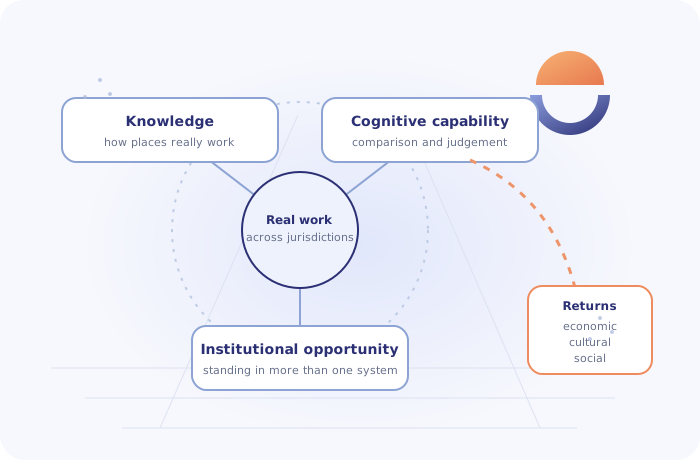
| The family | A verifiable result: research with measured data, documents in the form fairs expect, a disclosure statement that makes authorship clear. Knowledge, judgement and opportunity accumulated in one project. |
| Judges and admissions readers | Among thousands of projects built on standard microcontrollers, one with its own silicon and a silicon-versus-simulation comparison is remembered, and the student can explain every step. |
| Schools | A semiconductor design programme a teacher can run without a semiconductor background, with the group’s engineers behind it. |
What we do not claim
A toolchain is not a moat; any platform can add a block interface. What Magellan Silicon builds over time is the service, the research, the results pathway, the Taiwan supply chain and the group’s talent network, and what those accumulate: a library of silicon-verified student designs, research data on human–AI collaboration, and a record of competition entries and publications, cohort by cohort. We also do not claim that Magellan Silicon replaces a coding platform or a robotics league; most students will use both before and alongside it.