

The research programme
MTRI, the group’s research institute, runs a research programme alongside Magellan Silicon, led from its Singapore campus with a focus on human–AI interaction and learning. It studies four questions:
- How does working with an AI assistant on a hands-on hardware project build a young person’s ability to frame a problem, and how does that ability transfer?
- What kind of AI scaffolding keeps authorship and understanding with the student rather than quietly taking over, and how can that be measured?
- How does a young person’s mental model of “a chip” form when the design target is silicon rather than code, and what block granularity gives creative freedom without losing them?
- What learning outcomes does the programme produce at school scale, compared with a conventional electronics or coding course?
Methods are the ordinary ones of the field: co-design workshops with students, pilot studies, and cohort studies with pre- and post-measures, using interaction logs, notebooks and the artefacts themselves. Participation in research is separate from participation in the programme: it needs the parent’s separate consent, can be withdrawn at any time without affecting the student’s place, and uses de-identified data. Results are published whether or not they favour the programme, in peer-reviewed venues in human–computer interaction, machine learning, natural-language processing and engineering education, and summarised on the research page as they appear. This research connects to the group’s Mobility Capital work: knowledge, judgement and opportunity, studied at the scale of a first project.
How journeys become opportunity
Magellan Global’s name recalls a voyage, and the story behind the name describes a pattern: people who crossed into an unfamiliar world brought back an understanding of how it worked, and that understanding became opportunity. The group’s Mobility Capital framework studies the same pattern in adults who work across borders.
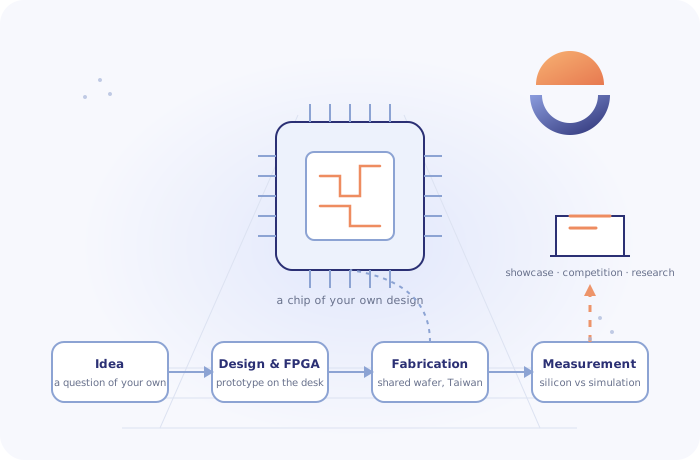
Magellan Silicon applies it to a young person’s first journey. The crossing is not only geographic. A student who can write code crosses into hardware, into manufacturing, into the laboratories and factories of Taiwan, and onto an international stage. They come back with knowledge of how things are made, with judgement formed by real trade-offs and real measurements, and with opportunities that follow from a result of their own. Knowledge, judgement and opportunity are the three components of Mobility Capital; a first chip is where many young people will begin to accumulate them.
From Magellan Silicon to GSRP: one pathway
The group runs two programmes on the same principle. GSRP develops enterprise-nominated successors and key people through AI capability, genuine work and international experience. Magellan Silicon does the same for students aged 12 to 17, at the scale of a first project. Families planning a successor’s development can begin years earlier; outstanding Magellan Silicon participants may later be introduced to GSRP-related internships and to the group’s talent network. Research on both programmes is carried by MTRI, and family education planning is supported through AJPE.